

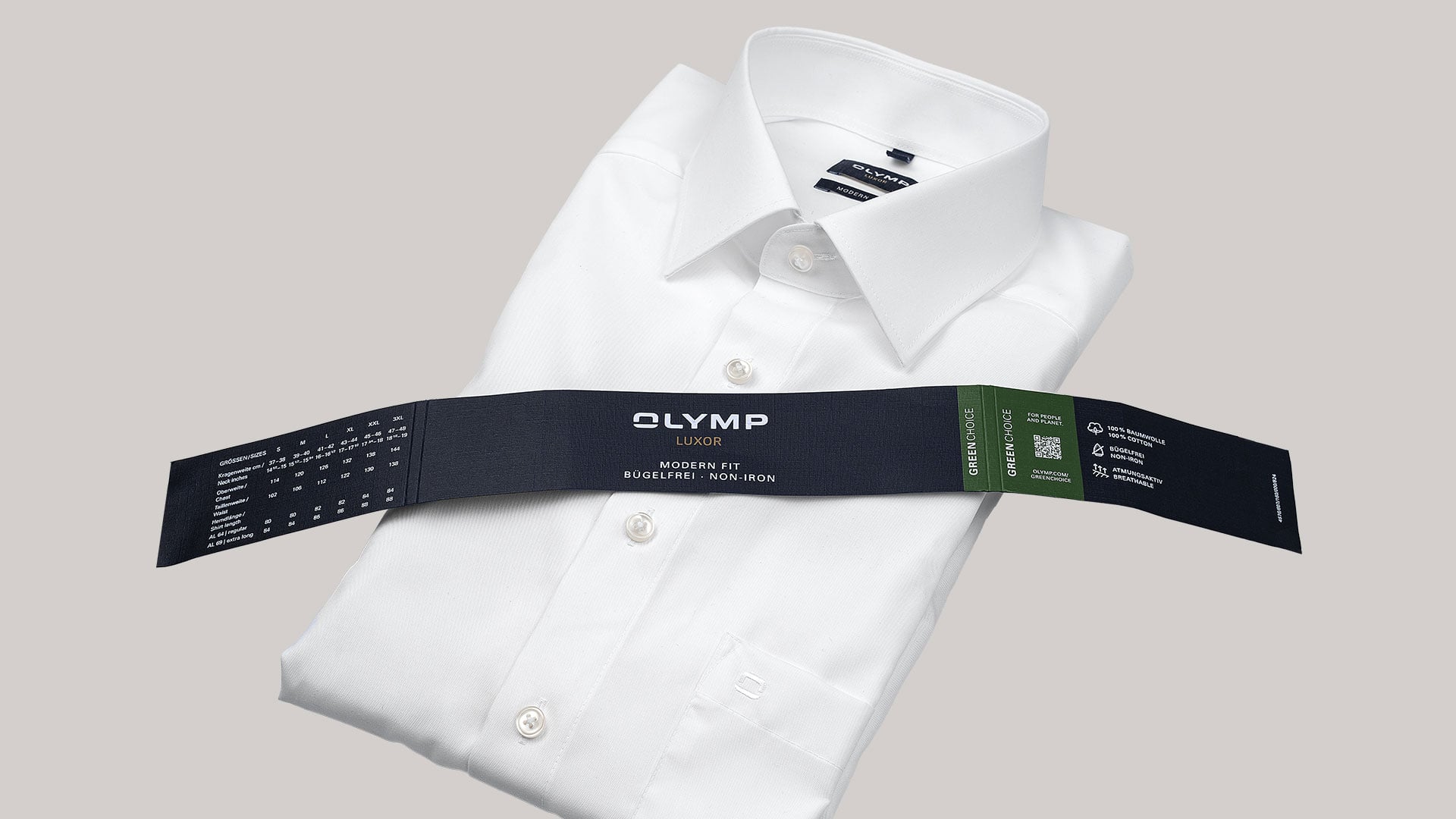
GREEN CHOICE: OLYMP signals its commitment to sustainability.
With the sustainability label "Green Choice", we mark products that stand out for their ecological sustainability: more sustainable materials, environmentally friendlier production, and more sustainable product packaging. All verified by independent seals.
BORIS HERRMANN × OLYMP
100% certified organic cotton or organic linen, buttons made of tagua nut, and sewing threads made of cotton or cellulose fibers - "All Nature" is the headline of our first joint collection with professional sailor, climate activist, and ambassador of OLYMP Green Choice, Boris Herrmann.
The Global Organic Textile Standard (GOTS) is the world’s leading textile processing standard for organic fibres. The GOTS lays down strict requirements for environmentally friendly and socially responsible production at every stage of the textile supply chain – starting with a ban on genetically modified raw materials, to restrictions on the use of chemicals and dyes, and requirements for ingredients and production processes, to strict residue and quality parameters. The entire textile supply chain is subject to an independent and transparent certification process.
The Organic Content Standard (OCS) provides clear evidence of the percentage of organic fibres in a finished product. Depending on its level, the standard awards the label OCS Blended or OCS 100. Organic cotton is grown following strict organic criteria. For example, the use of genetically modified seeds is prohibited, as is the use of synthetic pesticides and fertilisers.
The Responsible Wool Standard (RWS) ensures that the wool used comes from farms that consider animal welfare and sustainable pasture management. For the labeled items, all wool fiber is sourced from sheep raised in a species-appropriate manner. Moreover, the use of mulesing can be excluded. Through the Responsible Wool Standard (RWS), the use of Responsible Wool can be clearly demonstrated. Regular audits are carried out by independent certification bodies.
Wool certified according to the Responsible Wool Standard (RWS) can be found in some of our knitwear.
TENCEL™ is a trademark of Lenzing AG. TENCEL™ Lyocell and Modal fibers are derived from controlled or certified wood sources. TENCEL™ Lyocell and Modal fibers are made with at least 50% less carbon emissions and water consumption compared to generic lyocell and modal.* *Results based on LCA standards (ISO 14040/44) and available via Higg MSI (Version 3.7).
The more sustainable TENCEL™ fibres from Lenzing can be found in various lines of our product portfolio.
LENZING™ and ECOVERO™ are trademarks of Lenzing AG. LENZING™ ECOVERO™ fibers are made from controlled or certified wood sources, and made with at least 50% less carbon emissions and water consumption* * Compared to generic (unbranded) viscose Results based on LCA standards (ISO 14040/44) and available via Higg MSI (Version 3.7).
Flax, from which linen is obtained, is a particularly hardy plant. It grows in temperate zones, doesn’t need artificial irrigation and needs hardly any fertilisers. In contrast to conventional cotton cultivation, far fewer pesticides are used as well. By using linen from Germany, Belgium, France and the Netherlands, we promote the regional cultivation of this natural fibre. Linen from Western European cultivation is found in selected polos and T-shirts from the OLYMP Casual segment.

The OEKO-TEX® MADE IN GREEN product label identifies products that have been manufactured under sustainable and socially responsible conditions: From yarn to finished product, they are made in factories that are more environmentally friendly and in workplaces that are safe and socially responsible, certified by OEKO-TEX® STeP. Provides certainty that a textile is made from materials tested for harmful substances, guaranteed by OEKO-TEX® STANDARD 100
Sustainable Textile and Leather Production (OEKO-TEX® STeP) is an independent certification system for production companies at all stages of the textile chain. OEKO-TEX® STeP aims to permanently implement environmentally friendly production processes, improve occupational safety and promote socially acceptable working conditions in production facilities.

The Better Cotton Initiative promotes the cultivation of sustainably produced cotton worldwide. The focus is on training initiatives that provide cotton producers with comprehensive knowledge in the sustainable management of their farmland and improve working conditions in the regions of origin worldwide. Cotton sourcing through the Better Cotton Initiative is based on the principle of mass balance. To the same extent that OLYMP purchases Better Cotton, the cultivation of environmentally and socially responsible cotton is promoted worldwide. This means that Better Cotton is not necessarily physically present in the product.
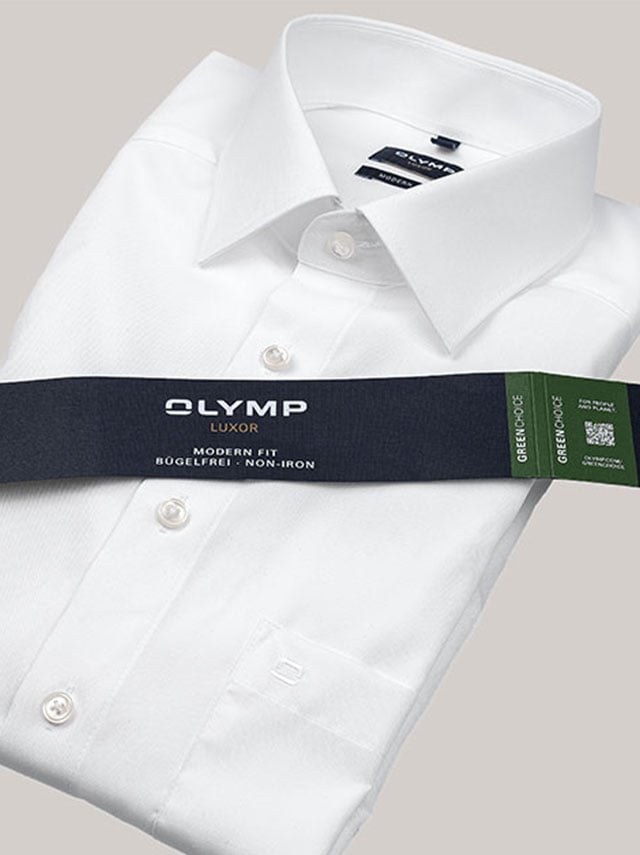
At OLYMP, we have set ourselves the ambitious goal of minimising packaging waste and in particular of drastically reducing the plastic parts in our shirt packaging, of improving the recyclability of the packaging and therefore clearly reducing our CO2 footprint. All our packaging is optimised according to the principles "Reduce", "Recyclable" and "Recycled".
The promotion of socially acceptable working conditions in the manufacture of our products is a particularly high priority. This is not a product or range-specific claim, but a principled stance that is permanently, emphatically and independently advocated by GREEN CHOICE towards all its production partners. Work must be decent, safe and fair. As part of our Fair Wear membership, we work on this every day.